while loop
A while loop is a looping statement used to repeatedly execute a block of code as long as a specified condition remains True.
Unlike the for loop, the while loop is mainly used when we do not know exactly how many times the loop should repeat.
Explanation
-
A while loop repeats a block of code continuously until the condition becomes False.
The loop first checks the condition.
- If the condition is True → loop executes
- If the condition is False → loop stops
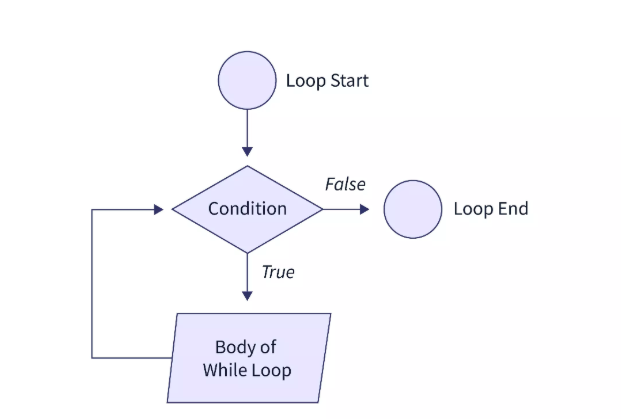
Step-by-Step Explanation of the Flowchart
1. Loop Start
The program starts the loop.
Initialization usually happens before the loop begins.
Example:
count = 12. Condition Check
The diamond shape checks the condition.
Example:
count <= 5Two possibilities occur:
3. Condition is True
If the condition is True:
- The body of the while loop executes.
- The statements inside the loop run.
Example:
print(count)4. Return Back to Condition
After executing the loop body:
- Control goes back to the condition.
- The condition is checked again.
Usually the variable is updated.
Example:
count = count + 1This process keeps repeating.
5. Condition is False
When the condition becomes False:
- The loop stops.
- Control moves outside the loop.
6. Loop End
The loop terminates completely.
The next statements after the loop will execute.
Real-Life Scenario
- Enter password until it is correct
- Playing a game until lives become 0
- Filling water until the tank is full
Loop runs until the condition becomes False
Syntax
initialization

while condition:
    statements
    increment/decrement
Explanation of Syntax
| Part | Meaning |
|---|---|
| Initialization | Starting value |
| while | Starts the loop |
| condition | Checks True or False |
| statements | Code repeated inside loop |
| increment/decrement | Updates loop variable |
Example 1
i = 1

while i <= 3:
    print("Hi")
    i += 1
Output
Hi
Hi
Hi
Example 2
num = 1
sum = 0

while num <= 5:
    sum += num
    num += 1

print(sum)
Output
15
Explanation of Example
- Loop runs from 1 to 5
- Adds values → 1+2+3+4+5 = 15
How While Loop Works
Step 1
Python first checks the condition.
Step 2
If the condition is True:
- the loop block executes
Step 3
The variable is updated using increment or decrement.
Step 4
Python again checks the condition.
The process repeats until the condition becomes False.
Why while loop is Important
While loops are important because they help programs:
- repeat tasks automatically
- handle unknown repetitions
- create interactive systems
- process real-time conditions
- build dynamic applications
Difference Between for Loop and while Loop
| Feature | for Loop | while Loop |
|---|---|---|
| Use | Fixed repetitions | Condition-based |
| Easy | Easy | Medium |
| Risk | Less | Can cause infinite loop |
Common Beginner Mistakes
| Mistake | Problem |
|---|---|
| Forgetting increment/decrement | Infinite loop |
| Wrong condition | Incorrect output |
| Forgetting indentation | Indentation error |
Missing colon : |
Syntax error |
➤ Summary
-
The while loop in Python is used to repeat a block of code as long as a condition remains True.
Important concepts include:
- initialization
- condition checking
- increment/decrement
- infinite loops