Functions (def)
Imagine you have a robot that knows how to make a sandwich. Instead of telling the robot every single step (get bread, add jam, close bread) every day, you just give that whole process a name: "MakeSandwich." Now, whenever you say that name, the robot does the job! In Python, we call this a function.
What is a Function?
A function is a reusable block of code that performs a specific task.
-
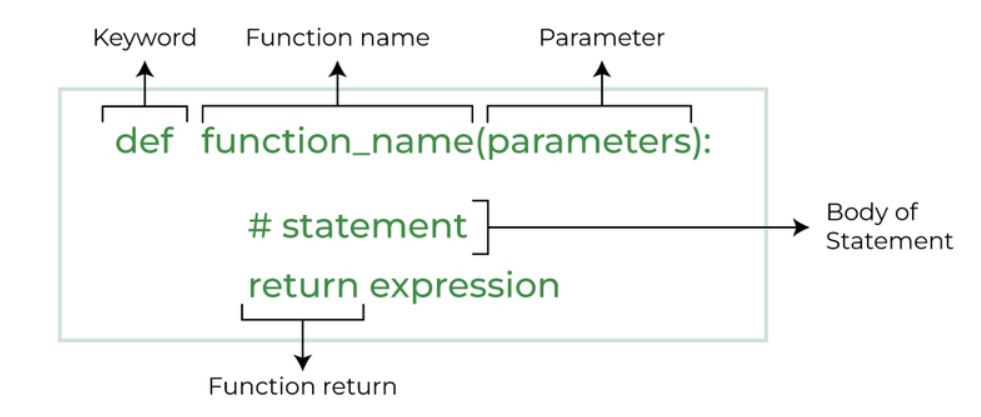
The def Keyword: We use this to "define" or create our function.
-
Called to Action: A function sits quietly in your code and only runs when it is called by its name.
-
Organization: They help you break a giant, messy program into small, easy-to-read "blocks."
The def Keyword
Python uses the:
def
keyword to create a function.
The word:
def
stands for:
define
Why Functions are Important
Functions are important because they:
- save time
- reduce duplicate code
- make programs easier to understand
- improve maintenance
- simplify debugging
Real-World Function Scenarios
-
ATM Machine: A function checks your account balance whenever you press the button.
-
Calculator: A function runs the math for addition or subtraction.
-
Login System: A function checks if your username and password are correct.
-
School Software: A function calculates your final grade and prints your report card.
Syntax
def function_name():
    statements
Syntax Explanation
| Part | Description |
|---|---|
| def | Keyword used to define a function |
| function_name | Name given to the function |
| () | Parentheses are mandatory |
| : | Colon symbol indicates the start of function block |
| statements | Instructions inside the function |
Example 1: The Greeting Machine
def greet():
    print("Hello Students")

# Calling the function to make it work
greet()
Output: Hello Students
Example 2: The Math Machine
def square():
    print(5 * 5)

square()
Output
25Benefits of Multiple Functions
- Better code organization
- Easier debugging
- Reusable code
- Professional coding style
Real-Time Applications of Functions
| Application | Function Usage |
|---|---|
| ATM Machine | Balance checking |
| Calculator | Mathematical operations |
| School Software | Grade calculation |
| Banking Apps | Fund transfer |
| E-Commerce Sites | Order processing |
| Games | Character movement |
Advantages of Functions
- Reusable Code – Write the code once and use it multiple times whenever needed.
- Better Organization – Functions divide large programs into smaller and manageable sections.
- Easy Debugging – Errors can be identified and fixed inside a specific function quickly.
- Improved Readability – Functions make programs cleaner and easier to understand.
- Faster Development – Developers can save time by reusing existing functions.
- Reduced Errors – Less code repetition means fewer chances of making mistakes.
- Simplified Maintenance – Updating a function automatically updates its behavior everywhere it is used.
- Enhanced Productivity – Programmers can focus on solving problems instead of rewriting code.
Summary:
-
Stop Repeating: If you find yourself typing the same code twice, turn it into a function instead.
-
Clean Code: Functions make your program look professional and organized.
-
Easy Fixes: If there is a mistake, you only have to fix it once inside the function, and it's fixed everywhere!