Logical Operators
Logical operators are special operators used to combine conditional statements and return the output as either True or False.
What are Logical Operators in Python?
Logical operators are operators used to combine two or more conditions in Python.
The result of logical operators is always:
- True
- False
These are Boolean values.
Logical Operators in Python
Logical Operators are very important in Python programming because they help combine multiple conditions together.
When a program needs to check more than one condition at the same time, logical operators are used.
Logical operators are commonly used in:
- login systems
- online forms
- banking applications
- result processing
- games
- security systems
These operators help programs make smart decisions based on multiple conditions.
Why Logical Operators are Important
Logical operators are important because they help programs:
- check multiple conditions together
- make decisions
- validate data
- control program flow
- improve security systems
Without logical operators, checking multiple conditions would become difficult.
Types of Logical Operators in Python
Python mainly provides three logical operators.
| Operator | Meaning |
|---|---|
and |
Returns True if both conditions are True |
or |
Returns True if at least one condition is True |
not |
Reverses the result |
Real-Life Example
Logical operators are like decisions in real life:
- If you have a ticket AND ID → you can enter
- If you have money OR card → you can pay
- If it is NOT raining → you can go outside
Explanation
These operators help in decision-making by checking more than one condition at the same time.
They are commonly used in:
ifstatements- Loops
- Real-life problem solving
They always return a Boolean value (True/False).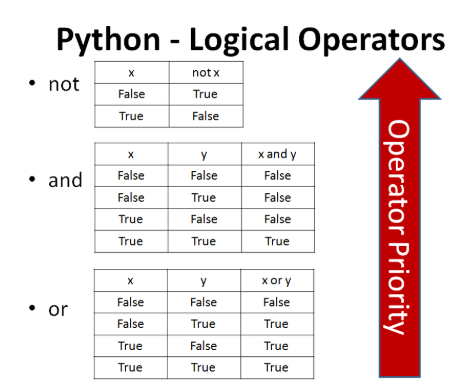
Example Program 1
a = 10

print(a > 5 and a < 20)
print(a > 15 or a < 20)
print(not(a > 5))
Output:
True
True
False
Example Program 2
age = 18
has_id = True

if age >= 18 and has_id:
    print("Eligible to vote")
else:
    print("Not eligible")
Output:
Eligible to voteExplanation
age >= 18→ checks if the person is 18 or olderhas_id→ checks if the person has an ID proofand→ both conditions must be True
Common Beginner Mistakes
| Mistake | Problem |
|---|---|
Using = instead of == |
Incorrect comparison |
| Forgetting brackets | Logic confusion |
| Mixing strings and integers | Type errors |
| Wrong logical condition | Incorrect output |
Summary
-
Logical Operators in Python are used to combine multiple conditions.
Python mainly provides three logical operators:
andornot
These operators always return either:
TrueFalse
Logical operators are widely used in real-world applications such as login systems, banking applications, school management systems, games, and security software.
Understanding logical operators is very important for learning decision-making and conditional programming in Python.